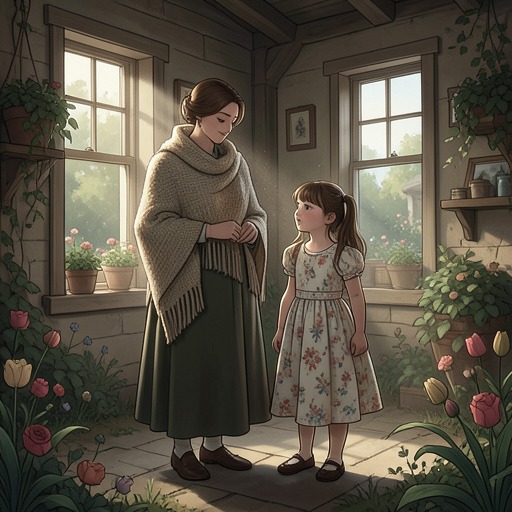
Dora Keith
Anne of the IslandDora Keith is a child at Green Gables whose small, practical gestures give her a distinct presence beside the more demonstrative Davy Keith. Usually composed and attentive to ordinary comforts, she is also reluctant to abandon Sunday School and plainly attached to Anne Shirley; her quietness is not indifference so much as a different way of showing feeling.
Identity and Temperament
Dora is eight years old and lives at Green Gables with Marilla Cuthbert and Davy. When she tumbles down the outside cellar steps, scraping the skin from her nose, Marilla puts her to bed. Davy cries over the accident, but not because Dora is hurt: he is bitter that he missed seeing her fall. The episode makes Dora the unwitting center of Davy’s comic disappointment, rather than giving her a dramatic response of her own.
Her composure is clearest on the morning Anne leaves. The household is subdued, and Davy cannot eat his porridge, but Dora eats comfortably and finishes his uneaten poached egg. She is sorry Anne is going, yet the sadness does not displace her appetite. The contrast makes her placidity concrete: even a family farewell does not stop her from appreciating breakfast.
Affection for Anne
Dora’s calm does not mean that Anne’s departure leaves her untouched. At the goodbye, she kisses Anne primly and manages two restrained tears. Davy, by contrast, has cried since breakfast and hides in a clothes closet rather than say goodbye. Their different responses distinguish Dora’s decorous expression of sorrow from Davy’s open distress.
When Anne returns, Dora clings to her hand as Davy hugs her knees. The welcome is set amid a bonfire and a brightly lit Green Gables, but Dora’s small gesture gives the reunion a personal measure: she does not need to lead the celebration to show that Anne’s return matters to her.
Sunday School and Davy’s Plans
Dora is less at ease when Davy draws her into an unwanted fishing expedition. She follows him against her will and warns him about breaking the Sabbath, while wishing she could be at her beloved Sunday School. At the Cotton children’s yard, the boys are alone; Dora is relieved that Mirabel is there, since she had feared being the only girl among them. She considers Mirabel noisy, sunburned, and reckless, but takes comfort in the fact that Mirabel wears dresses.
Dora’s frustration sharpens when she thinks about Frank Bell. She regrets that he kissed her, because without that incident she believes she could have defied Davy and gone to Sunday School. The text does not explain why the kiss limits her ability to refuse, but it makes her predicament explicit: she wants to resist Davy’s plan and return to a familiar religious routine, yet feels unable to do so.
Narrative Role
Dora’s characterization emerges through contrasts rather than a separate extended storyline. Her steady appetite offsets Davy’s theatrical distress; her prim farewell differs from his hiding; and her reluctance on the fishing trip complicates the image of an entirely unruffled child. Across these brief domestic scenes, she is at once composed, conventional in her manners, and capable of worry when Davy’s choices pull her away from what she values.